
As an Amazon Associate I earn from qualifying purchases. This guide is based on manufacturer specifications and published information, not hands-on testing. Running costs use the Ofgem price cap average electricity rate of 26.32p per kWh (1 October to 31 December 2026, Direct Debit).
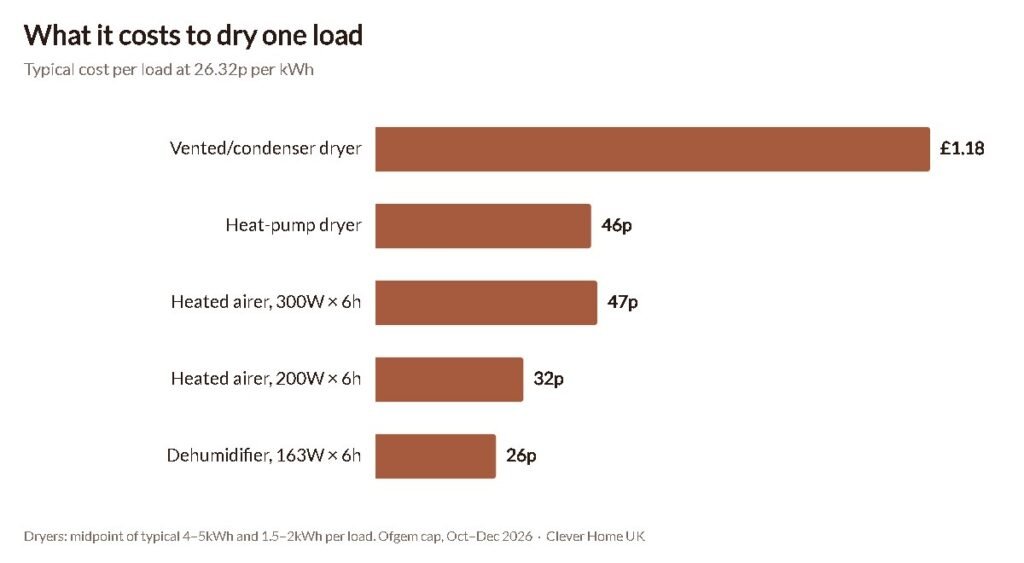
When the weather turns, most of us have three options for drying washing indoors: a tumble dryer, a heated airer, or a dehumidifier next to an ordinary airer. Here is roughly what each costs per load, so you can choose the cheapest option that still gets your washing dry.
The short answer
A heated airer or a dehumidifier usually costs far less per load than a vented or condenser tumble dryer, but takes much longer. A heat-pump tumble dryer sits in between: fast, and much cheaper to run than older dryers.
Cost per load compared
| Method | Energy per load (typical) | Cost per load |
|---|---|---|
| Vented or condenser tumble dryer | about 4 to 5kWh | £1.05 to £1.32 |
| Heat-pump tumble dryer | about 1.5 to 2kWh | 39p to 53p |
| Heated airer (300W for 6 hours) | 1.8kWh | 47p |
| Heated airer (200W for 6 hours) | 1.2kWh | 32p |
| Dehumidifier (163W for 6 hours) + ordinary airer | about 1kWh | 26p |
Costs use 26.32p per kWh. Tumble dryer figures are typical ranges for a full load of cottons; your machine may differ. Airer and dehumidifier figures assume they run at full rated power for 6 hours.
How to work out your own costs
You only need two numbers: how much power the appliance uses, and your electricity unit rate (it is on your bill, or use the price cap figure above).
- Airers, heaters and dehumidifiers: watts ÷ 1,000 × hours used = kWh. Multiply by your unit rate.
- Tumble dryers: the energy label shows the energy used per year, based on a set number of cycles (listed on the label). Divide the yearly kWh by the number of cycles to get a rough per-load figure, then multiply by your unit rate.
Example: a 300W airer running for 5 hours uses 0.3 × 5 = 1.5kWh. At 26.32p, that is about 39p.
Pros and cons of each
Tumble dryer
- Pros: fastest by far, about an hour or two; soft, crease-free results; no clothes around the house
- Cons: highest running cost for vented and condenser models; can shrink or wear delicate fabrics
Heated airer
- Pros: low running cost; gentle on clothes; cheap to buy
- Cons: slow; puts moisture into the room, which can cause condensation without ventilation
Dehumidifier with an airer
- Pros: very low cost per load; also tackles condensation and damp; the room stays drier
- Cons: higher upfront cost; works best in a closed, reasonably warm room
The cheapest way to dry indoors
Combining the two often works best: put a heated airer and a dehumidifier in the same small room with the door closed. The airer warms the clothes, and the dehumidifier removes the moisture they release. That speeds up drying and stops the water ending up on your windows and walls.
If you want to compare models, see our guides to the best heated airers and the best dehumidifiers for UK homes.
Ways to cut drying costs whatever you use
- Use the highest spin speed your fabrics allow. The drier clothes come out of the washer, the less energy it takes to finish them.
- Dry full loads in a tumble dryer, but don’t overfill it.
- Clean the dryer’s lint filter after every load and the condenser or heat-pump filter as the manual advises.
- Dry outside whenever you can, even on cold, breezy days.